
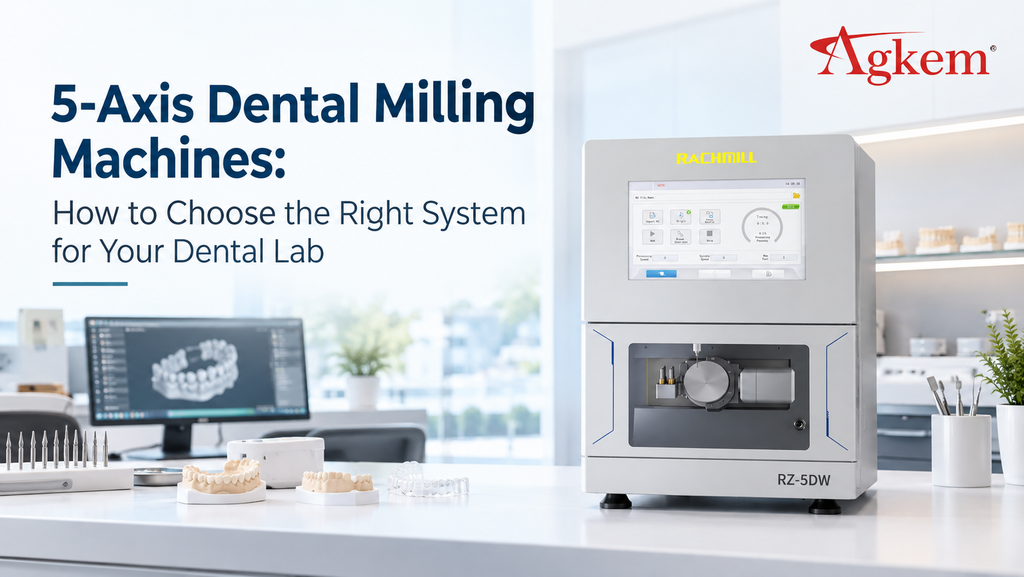
A dental laboratory looking to bring more CAD/CAM production in-house has several decisions to make, and the milling machine is one of the most important.
The right system needs to match the materials being processed, the types of restorations produced, expected case volume and the rest of the digital workflow.
A 5-axis dental milling machine gives laboratories greater freedom when machining complex dental designs.
Instead of limiting tool movement to three linear axes, the machine uses additional rotational movement to approach the restoration from different angles.
AGKEM offers several 5-axis dental milling systems, including wet, dry and wet/dry machines, along with 5-axis systems from DGSHAPE and XTCERA.
The specifications and intended applications vary considerably between models, so comparing them based on the laboratory’s actual requirements is more useful than simply looking for the machine with the highest specifications.
What Is a 5-Axis Dental Milling Machine?
A 5-axis dental milling machine is a computer-controlled system used to manufacture dental restorations and prosthetic components from digitally designed files.
The process generally begins with a digital impression or laboratory scan. The restoration is designed in CAD software, after which CAM software generates the machining instructions. The milling machine then cuts the selected dental material according to that design.
The additional rotational movement available in a 5-axis system allows the cutting tool to approach complex surfaces from different directions.
This can be useful for restorations with detailed anatomy, undercuts and other geometries that require more flexible tool positioning.
A 5-axis machine is therefore one part of a larger digital workflow:
Scanning → CAD design → CAM processing → Milling → Finishing
Depending on the material, the workflow may also include processes such as sintering, crystallisation, polishing or staining.
Why Do Dental Laboratories Use 5-Axis Milling?
The main reason is flexibility.
Dental restorations are not simple geometric shapes.
Anatomical contours, preparation margins, implant connections and undercuts can require the cutting tool to reach the workpiece from different directions.
A 5-axis machine can coordinate linear and rotational movements during machining, allowing it to handle these geometries more effectively.
The benefits can include:
- Access to more complex geometries
- Greater flexibility in tool positioning
- Support for a wider range of dental applications
- More automated production
- Integration with digital CAD/CAM workflows
- Reduced dependence on some manual manufacturing processes
The actual result still depends on the machine, CAM software, tooling, material and operator. Five axes alone do not determine milling quality.
4-Axis vs 5-Axis Dental Milling Machines
The difference comes down to movement.
A 4-axis machine adds one rotational axis to the three primary linear movements. A 5-axis machine adds another rotational movement, giving the cutting tool or workpiece greater freedom during machining.
For straightforward restorations, a 4-axis system may be sufficient. More complex work can benefit from the additional movement offered by 5-axis milling.
This is particularly relevant when a laboratory handles:
- Complex crowns and bridges
- Customized abutments
- Implant-supported restorations
- Implant bars
- Full-arch work
- Detailed anatomical restorations
- Cases involving difficult milling angles
The decision should therefore be based on the laboratory’s workload rather than simply choosing a 5-axis machine because it has an additional axis.
Dry, Wet or Wet & Dry Milling: Which Do You Need?
This is one of the first questions a dental laboratory should answer before selecting a milling machine.
1. Dry Milling
Dry milling is commonly used for materials such as zirconia, PMMA and wax.
AGKEM’s X-MILL 500 PLUS, for example, is a 5-axis dry milling machine with a 60,000 rpm maximum milling speed and an automatic 8-bur changer.
Its processing materials include zirconia, wax, PMMA and soft metal.
AGKEM also offers several DGSHAPE dry milling systems. The DWX-52D Plus supports materials including zirconia, wax, PMMA, composite resin, glass-fiber-reinforced resin and pre-sintered chrome cobalt, while the DWX-53D also supports materials such as PEEK, PEKK and CoCr sinter metal.
2. Wet Milling
Wet milling uses liquid during machining and is suitable for materials and applications that require this type of processing.
AGKEM’s X-MILL 600, for example, is a 5-axis wet milling system with a 2.5 kW spindle, automatic tool changing and support for materials including CoCr/NEM, titanium, PMMA, wax, glass ceramics and hybrid ceramics.
3. Wet & Dry Milling
A wet/dry system can provide greater flexibility when a laboratory wants to process different materials using one machine.
The AGKEM D5 Wet & Dry Milling Machine supports both milling modes and has a 60,000 rpm spindle, automatic 10-bur changing and support for zirconia, glass ceramic and PMMA.
Its case types include crowns and bridges, inlays and onlays, veneers, abutment crowns, splints and retainers, and removable dentures.
The 5 Axis Wet & Dry Milling Machine Rz – 5DW is another dual-purpose option.
It comes with a 2.5 kW spindle, 14-bur capacity, 60,000 rpm maximum speed and compatibility with zirconia, wax, PMMA, titanium discs, glass ceramic, resin and pre-milled titanium columns.
For a laboratory, the choice between dry, wet and wet/dry should start with the materials it actually intends to mill.
What Can a 5-Axis Dental Milling Machine Produce?
The applications depend on the machine, material and compatible CAM workflow.
Common dental applications include:
- Crowns
- Bridges
- Inlays
- Onlays
- Veneers
- Abutments
- Implant restorations
- Implant bars
- Splints
- Retainers
- Removable dentures
- Other digitally designed dental prosthetic components
AGKEM’s D5, for example, specifically lists crowns and bridges, inlays and onlays, veneers, abutment crowns, splints and retainers, and removable dentures among its millable case types. The X-MILL 500 PLUS additionally has customized abutments and implant bars.
Materials Used in Dental Milling
Material compatibility is an important part of machine selection.
1. Zirconia
Zirconia is widely used for digitally manufactured dental restorations. Several AGKEM dry and wet/dry milling systems support zirconia, including the D5 and X-MILL 500 PLUS.
2. PMMA
PMMA is used in a range of provisional and laboratory applications. AGKEM lists PMMA compatibility across several of its 5-axis systems.
3. Glass Ceramics
Glass ceramic processing requires an appropriate milling setup. The AGKEM D5 supports glass ceramic, while the X-MILL 630 is listed for glass ceramics and hybrid ceramics.
4. Titanium and Metal Materials
Metal compatibility varies significantly between milling machines.
The X-MILL 600 is listed for CoCr/NEM and titanium, while the 5DW supports titanium discs and pre-milled titanium columns.
These capabilities make material compatibility particularly important when comparing machines for implant-related laboratory work.
Best Place to Buy 5-Axis Dental Milling Machines Online in India
AGKEM 5-Axis Dental Milling Machines
AGKEM’s current CAD/CAM range includes several 5-axis milling systems.
They are not identical machines, and their specifications point toward different workflow requirements which are as follows:
1. AGKEM D5 Wet & Dry Milling Machine
The D5 is designed for laboratories looking for both wet and dry milling capability in one system.
Its listed specifications include:
- 5-axis milling
- 60,000 rpm maximum milling speed
- Wet and dry milling
- Automatic 10-bur changer
- 0.5 kW spindle
- A-axis rotation of 360°
- B-axis movement of ±30°/95°
- Zirconia, glass ceramic and PMMA compatibility
AGKEM lists average milling times of approximately 8 minutes for zirconia, 20 minutes for glass ceramic and 25 minutes for pre-mill abutments.
For laboratories working with several compatible material types and wanting wet/dry flexibility, these specifications make the D5 one of the machines to consider within AGKEM’s range.
2. 5 Axis Wet & Dry Milling Machine Rz – 5DW
The 5DW is another wet/dry option, but its configuration is different from the D5.
AGKEM lists a 2.5 kW spindle, 14-bur capacity, 60,000 rpm maximum speed and 5-axis movement. Its supported materials include zirconia, wax, PMMA, titanium discs, glass ceramic, resin and pre-milled titanium columns.
The machine also uses a C-shaped holder and supports glass ceramic blocks and pre-milled titanium columns.
For laboratories where material flexibility is an important consideration, these specifications are worth examining alongside the laboratory’s expected workload.
3. X-MILL 500 PLUS
The X-MILL 500 PLUS is a dry 5-axis milling machine.
AGKEM lists:
- 1.8 kW spindle
- 60,000 rpm maximum speed
- Automatic 8-bur changer
- 5-axis movement
- Zirconia, wax, PMMA and soft metal compatibility
- Crown and bridge production
- Inlays and onlays
- Veneers
- Customized abutments
- Abutment crowns
- Splints and retainers
- Removable dentures
- Implant bars
- Malo bridges
AGKEM lists average milling times of approximately 8 minutes for zirconia and 3 minutes for wax.
This makes the X-MILL 500 PLUS particularly relevant to laboratories looking for a dry milling workflow with a range of commonly used dental materials and applications.
4. X-MILL 600
The X-MILL 600 takes a different approach.
It is a wet 5-axis simultaneous milling machine with a 2.5 kW spindle and automatic tool changing. AGKEM lists a 16-tool automatic changer, 60,000 rpm maximum speed and a milling range of XYZ 320/130/150 mm with A-axis rotation of 360° and B-axis movement of ±40°.
Its listed materials include:
- CoCr/NEM
- Titanium
- PMMA
- Wax
AGKEM also lists approximate milling times of 30 minutes for a crown, 50 minutes for an abutment and 2 hours for a bar.
For laboratories looking at wet milling and applications involving materials such as titanium or CoCr/NEM, this configuration deserves consideration.
5. DGSHAPE 5-Axis Dental Milling Machines
AGKEM’s CAD/CAM category also includes several DGSHAPE 5-axis dry milling systems, including the DWX-52D Plus, DWX-52Di Plus, DWX-53D and DWX-53DC.
The DWX-52Di Plus supports materials including zirconia, wax, PMMA, composite resin, PEEK, PEKK, gypsum, glass-fiber-reinforced resin, CoCr sinter metal and polycarbonate. It also has a 15-bur capacity and A/B rotary movement.
The DWX-53D is another dry 5-axis system with automatic calibration, a 15-bur capacity and support for materials including zirconia, wax, PMMA, PEEK, PEKK, glass-fiber-reinforced resin, composite resin and CoCr sinter metal.
The DWX-53DC adds a 6-slot automatic disc changer alongside a 15-station automatic tool changer and an open CAD/CAM system.
These differences matter when a laboratory is comparing machines for production volume, material requirements and automation.
How to Choose a 5-Axis Dental Milling Machine
There is no single specification that determines whether a milling machine is suitable for a laboratory.
Instead, consider the following.
1. Start With Your Materials
Make a list of the materials your laboratory currently mills.
If zirconia and PMMA account for most of your production, a dry or wet/dry system may be sufficient. If your workflow includes titanium, CoCr/NEM or glass ceramics, the material compatibility of each machine becomes much more important.
2. Consider the Type of Cases You Produce
A laboratory focused on crowns and bridges may have different requirements from one producing implant bars, customized abutments or more complex prosthetic work.
Match the machine’s listed applications to the actual cases you receive.
3. Decide Between Dry, Wet and Wet/Dry
This should be based on the materials and production workflow rather than preference alone.
Wet/dry systems offer flexibility, while dedicated dry or wet machines can be more appropriate when a laboratory has a clearly defined material workflow.
4. Look at Tool Capacity
Automatic tool changing can reduce the need for manual intervention.
AGKEM’s machines vary in tool capacity. The D5 has a 10-bur automatic changer, the 5DW has a 14-bur capacity, the X-MILL 500 PLUS has 8 burs, and the X-MILL 600 has a 16-tool automatic changer.
5. Check Automation Features
For a growing laboratory, automation can become increasingly relevant.
Disc changers, automatic tool changing, calibration and monitoring features can help reduce manual intervention. The DGSHAPE DWX-53DC, for example, includes a 6-slot automatic disc changer and 15-station automatic tool changer.
6. Check the Complete CAD/CAM Workflow
A milling machine does not work alone.
Before purchasing, consider:
- Scanner compatibility
- CAD software
- CAM software
- File formats
- Material libraries
- Extraction or coolant requirements
- Sintering equipment
- Finishing equipment
- Installation
- Training
- Service support
An otherwise capable machine can become difficult to use if it does not fit the rest of the laboratory’s digital workflow.
How Much Does a 5-Axis Dental Milling Machine Cost in India?
The cost of a 5-axis dental milling machine varies depending on the machine configuration, manufacturer, milling mode, automation, material compatibility, software, accessories and installation requirements.
AGKEM’s current range includes machines with substantially different configurations, from compact dry systems to larger wet milling systems and automated production-oriented machines.
That means a single “5-axis milling machine price” is not particularly useful for making a purchasing decision.
Instead, laboratories should compare the complete investment, including:
- Machine cost
- CAM software
- Milling burs
- Extraction or coolant equipment
- Installation
- Training
- Maintenance
- Replacement components
- Material consumption
A quotation based on the laboratory’s intended workflow can provide a more useful comparison than a machine-only price.
Which AGKEM 5-Axis Milling Machine Is Right for Your Dental Lab?
The right choice depends on the laboratory’s workflow.
- For wet and dry flexibility: The D5 and 5DW are both dual-purpose systems, with different spindle configurations, tool capacities and material specifications.
- For dry milling of common dental materials: The X-MILL 500 PLUS is designed around a dry workflow and supports zirconia, wax, PMMA and soft metal.
- For wet milling and broader material requirements: The X-MILL 600 is listed for wet milling and supports materials including titanium, CoCr/NEM and glass ceramics.
- For automated digital workflows: The DGSHAPE range includes systems with features such as automatic tool changing, automatic calibration, open CAD/CAM compatibility and, on the DWX-53DC, automatic disc changing.
The important point is that these are different configurations for different requirements.
A laboratory should compare them against its case mix, materials, production volume, available space and desired level of automation.
Frequently Asked Questions
1. What is a 5-axis dental milling machine?
A 5-axis dental milling machine is a computer-controlled system that uses five coordinated axes of movement to manufacture digitally designed dental restorations and prosthetic components.
2. What is the advantage of a 5-axis dental milling machine?
The additional rotational movement gives the cutting tool greater access to complex surfaces and angles, which can be useful for detailed dental restorations and implant-related work.
3. What materials can AGKEM 5-axis milling machines process?
The answer depends on the model. AGKEM lists zirconia, PMMA, wax, glass ceramics, titanium, soft metals, CoCr/NEM and other materials across its different 5-axis systems. Material compatibility should always be checked against the specific machine.
4. Which AGKEM milling machine supports both wet and dry milling?
The AGKEM D5 and 5 Axis Wet & Dry Milling Machine Rz – 5DW are listed as wet and dry milling systems.
5. What is the difference between the D5 and X-MILL 500 PLUS?
The D5 supports both wet and dry milling and is listed for zirconia, glass ceramic and PMMA. The X-MILL 500 PLUS is a dry milling system supporting zirconia, wax, PMMA and soft metal. Their spindle configurations, bur capacities and listed case applications also differ.
6. Is the X-MILL 600 a wet or dry milling machine?
The X-MILL 600 is a wet 5-axis milling machine. AGKEM lists support for materials including CoCr/NEM, titanium, PMMA, wax, glass ceramics and hybrid ceramics.
7. Can a 5-axis dental milling machine mill titanium?
Some can. For example, AGKEM lists titanium compatibility for the X-MILL 600 and the 5DW. Other machines may have different material limitations, so titanium compatibility should be confirmed for the exact model.
8. How many burs does a 5-axis dental milling machine need?
There is no universal requirement. Tool capacity depends on the materials and workflow. AGKEM’s current machines have different capacities, including 8, 10, 14 and 16 tools or burs depending on the model.
9. Is a 5-axis milling machine suitable for a new dental laboratory?
It can be, particularly if the laboratory plans to build an in-house digital production workflow. The appropriate model depends on expected case volume, materials, applications, available space and budget.
10. How do I choose the right 5-axis dental milling machine?
Start by identifying the materials and restorations you produce, then compare wet/dry capability, spindle performance, tool capacity, automation, software compatibility, service requirements and total operating costs.
11. How much does a 5-axis dental milling machine cost in India?
Prices vary by model and configuration. The most useful approach is to request a quotation based on the laboratory’s intended workflow, including the machine, software, accessories, installation and other required equipment.