
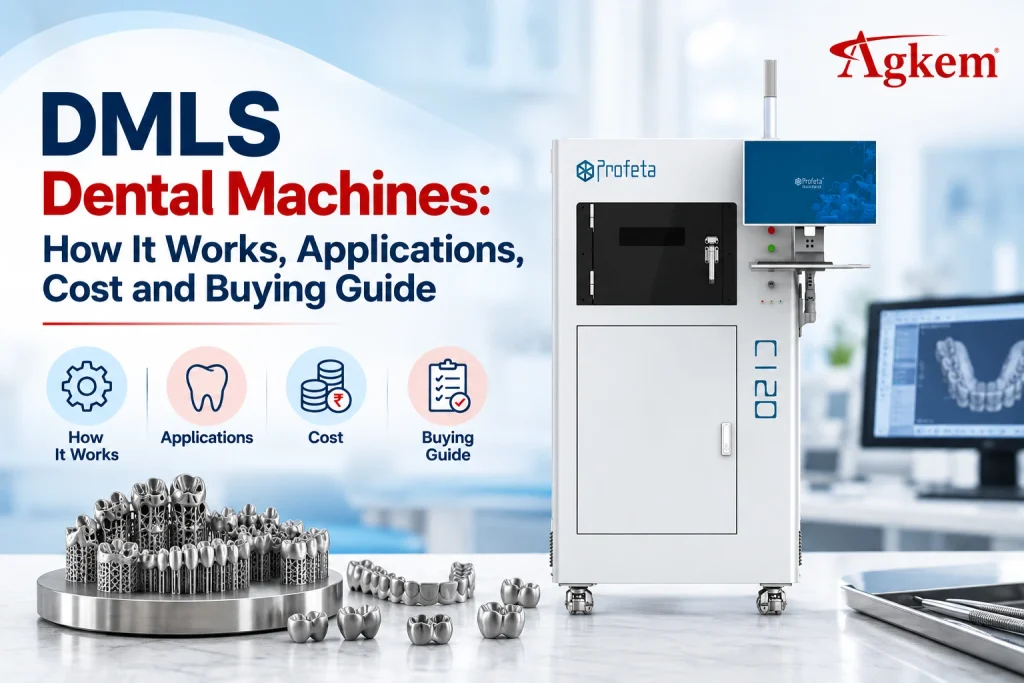
Dental laboratories are increasingly adopting metal 3D printing to manufacture complex dental components with consistent digital workflows.
Direct Metal Laser Sintering (DMLS) is one of the technologies used to produce metal parts from digital designs, particularly for applications involving cobalt-chromium and other compatible metal powders.
For dental laboratories considering this technology, choosing a DMLS machine involves evaluating build volume, laser configuration, supported materials, printing speed, powder handling, software and post-processing requirements. The overall investment also includes more than the printer itself.
This guide explains how DMLS dental machines work, where they are used, which features to compare and what affects DMLS machine prices in India.
What Is a DMLS Dental Machine?
A DMLS dental machine is a metal additive manufacturing system that uses a laser to fuse metal powder in successive layers according to a digital design.
The process creates a three-dimensional component from a computer-generated model.
DMLS is commonly associated with metal powder made from materials such as cobalt-chromium alloys.
Depending on the machine and validated material configuration, metal additive manufacturing can also support other applications and materials.
In dentistry, DMLS technology is used by dental laboratories and manufacturing centres that require digitally produced metal frameworks, removable partial denture components, copings, implant-related structures and selected orthodontic appliances.
Unlike conventional milling, which removes material from a block, DMLS builds components layer by layer.
This can be useful when the design includes complex geometries or when a laboratory needs to produce multiple components in a single build.
How Does DMLS Metal 3D Printing Work?
A typical DMLS workflow involves several stages, from digital design to final finishing.
1. Digital Design
The dental component is designed using compatible dental CAD software or prepared from an existing digital model.
The design must account for the intended application, material, manufacturing requirements and any necessary finishing procedures.
2. File Preparation and Slicing
The digital model is prepared in compatible software and divided into thin layers. The software determines how the machine will build the component and generates the instructions required for printing.
3. Metal Powder Deposition
A thin layer of suitable metal powder is distributed across the build platform. The machine prepares the powder bed according to its operating process.
4. Laser Fusion
The laser scans selected areas of the powder bed and fuses the material according to the programmed layer data. The process repeats layer by layer until the components have been built.
5. Cooling and Part Removal
After printing, the build must follow the machine’s prescribed cooling and handling procedures.
Components are then removed from the build platform according to the required safety and operating protocols.
6. Post-Processing and Quality Checks
Printed components may require support removal, heat treatment, surface finishing, polishing or other post-processing steps, depending on the material and application.
Final inspection is important before the component proceeds to the next stage of the dental workflow.
A DMLS printer is therefore one part of a broader manufacturing system. Software, powder management, finishing equipment, operator training and quality control all contribute to the final production process.
Applications of DMLS in Dental Laboratories
DMLS technology can support several metal manufacturing applications in dentistry. The exact applications depend on the printer, validated materials, design workflow and applicable clinical or laboratory requirements.
Common applications include:
- Removable partial denture frameworks: Digital manufacturing of compatible metal framework designs.
- Dental copings and frameworks: Production of selected metal components used in restorative workflows.
- Implant bars and structures: Manufacturing of compatible implant-related components according to the design and material requirements.
- Orthodontic appliances: Production of selected metal appliances and components.
- Dental laboratory production: Batch manufacturing of multiple components within a single build, depending on the machine’s capacity and design arrangement.
Before selecting a DMLS machine, dental laboratories should identify their main applications and confirm that the proposed system supports the required materials, dimensions and manufacturing processes.
Key Features to Compare When Buying a DMLS Machine
1. Build Volume
Build volume determines the maximum space available for manufacturing components in a single build. It influences how parts can be arranged and how many suitable components may fit within the build area.
For example, AGKEM lists the Profeta C120 with a build volume of 120 mm diameter by 70 mm height. The Profeta IE150 has a larger listed build volume of 158 mm diameter by 70 mm height.
A larger build volume may provide more flexibility, but actual output depends on component dimensions, spacing, supports, material requirements and build settings.
2. Laser Configuration and Power
DMLS systems may use a single laser or multiple lasers. Laser configuration can affect how the machine handles the build and may influence production speed, depending on the system design and operating parameters.
AGKEM’s Profeta IE150 and VP100 Pro listings describe single- or dual-laser configurations, with Yb-fiber laser options specified at 200 W or 300 W.
3. Supported Materials
Material compatibility is a critical purchasing consideration.
Dental laboratories should confirm the metal powders supported by the machine and whether the complete workflow has been validated for the intended applications.
For example, AGKEM’s Profeta VP100 Pro has a dual-mode system supporting cobalt-chromium and titanium, with the option to switch between material modes.
4. Layer Thickness
Layer thickness affects the way a component is built and may influence surface characteristics, production time and dimensional outcomes.
AGKEM provides a 20 to 50 micron layer-thickness range for the Profeta C120 and IE150.
The most appropriate setting depends on the machine, material, component geometry and validated process parameters.
A thinner layer should not automatically be treated as a guarantee of better final results.
5. Powder Handling and Safety
Metal powder management is an essential part of operating a DMLS system. Buyers should assess powder loading, recovery, sieving, cleaning, storage and disposal procedures, along with the manufacturer’s recommended protective measures.
The VP100 Pro listing includes a glove box and built-in cleaner for closed powder cleaning. Dental laboratories should still review the complete installation, ventilation, personal protective equipment and workplace safety requirements before operating the equipment.
6. Software and Workflow Integration
Check which design, slicing and build-preparation software is included, along with the available file formats and integration requirements.
A system that fits the laboratory’s existing digital workflow can simplify implementation. Ask whether the quotation includes the necessary software, training and setup support.
7. Post-Processing Requirements
The printed component may need further processing before it is ready for its intended use. Ask about compatible heat-treatment equipment, support removal, finishing, polishing and inspection procedures.
AGKEM’s Profeta C120 and IE150 provide a one-stop solution package that includes design software, slicing software, a furnace and a nitrogen generator.
DMLS vs Dental Milling: What Is the Difference?
DMLS and dental milling are two different manufacturing approaches.
Dental milling removes material from a block or disc using cutting tools. It is widely used for compatible materials such as zirconia, PMMA, wax and selected metals, depending on the milling machine.
DMLS builds metal components layer by layer using a laser and metal powder. It can be useful for compatible metal components and designs that benefit from additive manufacturing.
The better choice depends on the intended material, component geometry, production volume, equipment cost, finishing requirements and existing dental laboratory workflow.
Some dental laboratories may use both technologies for different applications rather than treating them as direct replacements for one another.
DMLS Machine Price in India
The price of a DMLS machine in India varies according to the model, build volume, laser configuration, supported materials, software, automation and included accessories.
Installation, training, warranty, maintenance and technical support can also influence the total investment.
A machine supplied as part of a wider production package may include equipment and software that would otherwise need to be purchased separately.
Buyers should compare the complete package rather than looking only at the printer’s quoted price.
Before requesting a quotation, consider:
- Required build volume and daily production targets
- Single-laser or dual-laser configuration
- Supported materials and powder requirements
- Software and build-preparation tools
- Powder handling and safety equipment
- Post-processing and finishing equipment
- Installation, training and ongoing technical support
There is no single price that applies to every DMLS machine. Request a current quotation based on your laboratory’s applications and required configuration.
Buy DMLS Metal 3D Printers Online at AGKEM
AGKEM lists several Profeta metal 3D printers in its DMLS category for buyers evaluating dental metal additive manufacturing equipment.
Profeta C120 Metal 3D Printer
The Profeta C120 comes with a 120 mm diameter by 70 mm build volume, a 300 W Yb-fiber laser and a specified layer thickness of 20 or 50 micron.
It has a compact design and a solution package that includes design software, slicing software, a furnace and a nitrogen generator.
Profeta IE150 Metal 3D Printer
The Profeta IE150 comes with a 158 mm diameter by 70 mm build volume and single- or dual-laser configurations.
It also has the dual-laser option, support for 20 to 50 micron layer thicknesses and a package intended to support the broader production workflow.
Profeta VP100 Pro Metal 3D Printer
The VP100 Pro is described as a dental metal 3D printer with single- or dual-laser options and a 120 mm diameter by 70 mm build volume.
It comes with support for cobalt-chromium and titanium in a dual-mode configuration, along with closed powder-cleaning features.
This model may be worth evaluating for dental laboratories that need to consider material switching as part of their workflow. Confirm the offered configuration, switching process and operating requirements with AGKEM.
To compare additional models, visit the AGKEM DMLS machine category.
How to Choose the Right DMLS Machine for Your Dental Laboratory
Before investing in metal 3D printing, assess how the equipment will fit into your production process.
- Define your applications: Identify the metal components and dental appliances you intend to manufacture.
- Estimate production volume: Consider the number of cases you expect to process and whether batch production is important.
- Compare build volumes: Match the available build area to your component dimensions and production plans.
- Confirm material compatibility: Check supported powders and the manufacturer’s validated processing requirements.
- Review the complete workflow: Include software, powder handling, finishing, inspection and other required equipment.
- Calculate total ownership cost: Account for installation, consumables, maintenance, training and ongoing support.
- Assess technical assistance: Confirm warranty terms, operator training and the availability of service support.
A well-matched system should meet the dental laboratory’s production needs while fitting its available space, staff expertise and budget.
Frequently Asked Questions
1. What is a DMLS dental machine?
A DMLS dental machine uses a laser to fuse metal powder layer by layer to manufacture three-dimensional components from digital designs. In dental laboratories, it can be used for compatible metal frameworks, copings, implant-related structures and selected appliances.
2. What does DMLS stand for?
DMLS stands for Direct Metal Laser Sintering. It is a metal additive manufacturing process in which a laser fuses successive layers of metal powder according to digital build instructions.
3. What materials can a dental DMLS machine process?
Material compatibility depends on the machine and its configuration. Cobalt-chromium is used in dental metal printing, while selected systems may also support titanium. Always confirm approved materials and processing requirements with the equipment supplier.
4. How much does a DMLS machine cost in India?
The cost depends on build volume, laser configuration, supported materials, software, automation and the equipment included in the package. Request a current quotation based on your intended applications.
5. What is the difference between DMLS and dental milling?
DMLS builds components layer by layer from metal powder, while milling removes material from a block or disc. The appropriate method depends on the material, design, production requirements and finishing workflow.
6. Is a dual-laser DMLS machine better than a single-laser model?
A dual-laser configuration may offer production advantages depending on the machine design and build parameters. Compare actual productivity, supported materials, build volume and operating costs before choosing between configurations.
7. What equipment is required alongside a DMLS printer?
Depending on the system, the workflow may require design and slicing software, powder-handling equipment, protective equipment, a suitable furnace, finishing tools and inspection processes. Check which components are included in the quoted package.
8. Where can I buy a DMLS dental machine in India?
AGKEM lists Profeta metal 3D printers, including the C120, IE150 and VP100 Pro. Visit the AGKEM DMLS category to compare available models and enquire about pricing.
Explore DMLS Metal 3D Printing Solutions at AGKEM
Selecting a DMLS dental machine requires a clear understanding of your materials, component designs, production volume and post-processing needs.
Build volume, laser configuration, software, powder handling and technical support should all be considered when comparing equipment.
Explore AGKEM’s range of DMLS metal 3D printers to evaluate the available configurations and identify a system that aligns with your dental laboratory’s manufacturing requirements.