
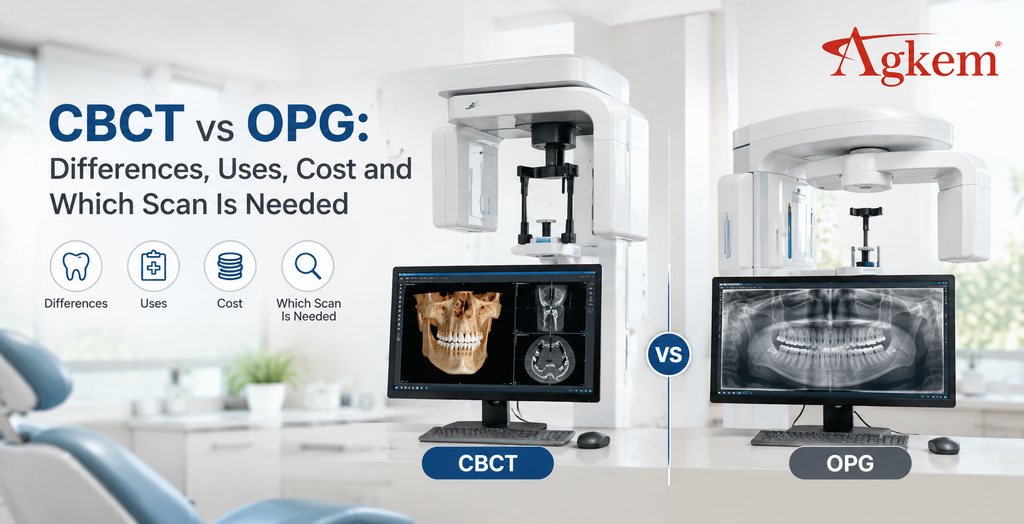
Dental imaging plays an important role in diagnosis and treatment planning, but different imaging systems answer different clinical questions. Two commonly discussed options are OPG and CBCT.
An OPG provides a two-dimensional panoramic view of the teeth and jaws.
CBCT, or Cone Beam Computed Tomography, creates three-dimensional images that can provide additional information about the position of teeth, bone and other anatomical structures.
The choice between CBCT and OPG is therefore not simply about choosing the newer technology. It depends on what the dentist needs to see, the clinical indication, the required level of detail and whether three-dimensional information will change diagnosis or treatment planning.
For dental practices considering imaging equipment, understanding the difference is also important when deciding whether an OPG system, a CBCT system or a multifunctional unit fits the practice’s workflow.
What Is an OPG?
OPG stands for Orthopantomogram. It is a panoramic dental X-ray that produces a two-dimensional image of the upper and lower jaws in a single scan.
Unlike an intraoral X-ray, which focuses on a smaller area, an OPG provides a broader overview of the dentition and surrounding structures.
An OPG may be used to assess:
- Overall dental development
- Wisdom teeth
- Impacted teeth
- General jaw anatomy
- Gross bone changes
- Tooth position
- Some jaw lesions
- Initial orthodontic assessment
- General treatment planning
An OPG is often useful when the dentist needs a broad overview rather than detailed three-dimensional information.
What Is CBCT?
CBCT stands for Cone Beam Computed Tomography.
Instead of producing a single two-dimensional panoramic image, a CBCT system captures multiple X-ray projections and reconstructs them into a three-dimensional volume.
This allows the clinician to examine the scanned area in different planes and evaluate spatial relationships that may not be visible clearly in a 2D image.
The FDA describes dental CBCT as a 3D imaging technique used in applications including implant planning, evaluation of abnormal teeth, jaw and facial assessment, endodontic diagnosis and dental trauma.
CBCT can be particularly useful when the clinical question requires information about:
- Bone dimensions
- Tooth position in three dimensions
- Root anatomy
- Impacted teeth
- Implant sites
- Anatomical structures
- Endodontic anatomy
- Maxillofacial structures
For more insights, explore our detailed guide on CBCT technology and its applications.
CBCT vs OPG: What Is the Main Difference?
The simplest distinction is:
OPG provides a 2D panoramic overview, while CBCT provides 3D information.
That difference affects how each system is used.
| Feature | OPG | CBCT |
| Image type | 2D | 3D |
| Main purpose | Broad panoramic overview | Detailed 3D assessment |
| Field of view | Broad panoramic region | Selected 3D volume, depending on system |
| Spatial information | Limited compared with 3D imaging | Provides 3D spatial information |
| Typical applications | General assessment, orthodontics, wisdom teeth | Implant planning, complex anatomy, endodontics and other 3D applications |
| Equipment cost | Generally lower | Generally higher |
| Radiation exposure | Generally lower | Generally higher than conventional dental X-rays |
| Data | Single panoramic image | 3D volume that can be viewed in multiple planes |
The exact radiation dose depends on the equipment, settings and examination. CBCT should be prescribed when the additional information is clinically justified rather than simply because 3D imaging is available.
When Is an OPG Used?
An OPG can be useful when the dentist needs a general view of the patient’s teeth and jaws.
1. Wisdom Teeth Assessment
An OPG can provide an overview of the position and development of wisdom teeth and can help identify cases where additional imaging may be required.
2. Orthodontic Assessment
Panoramic imaging can form part of an orthodontic assessment by providing a broad view of the dentition and developing teeth.
3. General Dental Assessment
When a dentist needs an overview of the dentition and jaw rather than detailed three-dimensional information, an OPG can be appropriate.
4. Initial Treatment Planning
An OPG can provide useful baseline information before deciding whether more focused or three-dimensional imaging is necessary.
The key point is that an OPG is not intended to replace CBCT when the clinical question requires 3D information.
When Is CBCT Used?
CBCT becomes more relevant when the dentist needs to understand anatomy in three dimensions.
1. Dental Implant Planning
Implant placement can require information about available bone and the relationship between the proposed implant site and nearby anatomical structures.
CBCT can provide three-dimensional information that is not available from a conventional panoramic image.
2. Impacted Teeth
For some impacted teeth, particularly where the relationship with surrounding anatomical structures needs to be understood, 3D imaging can provide additional information.
3. Endodontics
CBCT can be useful in selected endodontic cases where conventional radiographs do not provide enough information to answer the clinical question.
It may help in evaluating complex root anatomy, suspected pathology or other situations where three-dimensional information is relevant.
4. Oral Surgery
Complex surgical cases may require a clearer understanding of the spatial relationship between teeth, bone and surrounding structures.
5. Maxillofacial Assessment
CBCT can also be used for selected evaluations involving the jaws and facial structures.
The appropriate examination depends on the clinical indication and should be determined by the treating dental professional.
CBCT vs OPG for Dental Implants
Implant planning is one area where the difference between the two technologies becomes particularly important.
An OPG can provide an initial panoramic overview of the jaws.
However, implant planning may require information about bone dimensions and the three-dimensional position of anatomical structures.
CBCT can provide that additional 3D information.
A study examining the use of CBCT and OPG among dental practitioners found that CBCT was particularly associated with implant planning, while OPG was more commonly used for broader assessment and certain other treatment-planning situations.
This does not mean that every implant case automatically requires CBCT. The appropriate imaging method depends on the individual case and the clinical question being addressed.
CBCT vs OPG for Wisdom Teeth
Both imaging methods can have a role in wisdom-tooth assessment.
An OPG can show the general position of an impacted wisdom tooth and provide a broad view of the surrounding anatomy.
CBCT can be considered when three-dimensional information is needed, particularly when the spatial relationship between the tooth and important anatomical structures needs closer evaluation.
The decision should therefore be based on whether the additional 3D information is clinically necessary.
CBCT vs OPG for Root Canal Treatment
Conventional dental X-rays remain important in endodontics, but some complex cases may require additional imaging.
CBCT can provide three-dimensional information about root anatomy and surrounding structures that may be difficult to evaluate using conventional two-dimensional images.
It is not necessary for every root canal case. Its value depends on the clinical question and whether the additional information can affect diagnosis or treatment planning.
Does CBCT Have More Radiation Than OPG?
Generally, yes.
The radiation dose from a CBCT examination is typically higher than that from a conventional dental X-ray examination, although the actual dose varies considerably according to the CBCT machine, field of view, exposure settings and examination protocol.
The FDA notes that dental CBCT generally provides more radiation than conventional dental X-ray imaging, although doses are generally lower than those associated with medical CT examinations.
This is one reason CBCT should not simply be treated as an automatic replacement for 2D imaging.
The goal is to use the imaging method that provides the information required for the clinical question while avoiding unnecessary exposure.
Is CBCT Better Than OPG?
It is more accurate to say that CBCT and OPG serve different purposes.
CBCT provides 3D information that an OPG cannot provide. That makes it valuable when three-dimensional anatomy needs to be assessed.
An OPG, however, remains useful when a broad 2D panoramic view is sufficient.
So the question should not simply be “Which is better?”
A more useful question is:
Which imaging method provides the information required for this particular clinical situation?
That distinction is important for both diagnosis and equipment purchasing.
What Should a Dental Clinic Consider When Choosing Between OPG and CBCT Equipment?
For a dental practice investing in imaging equipment, clinical use is only one part of the decision.
1. Patient Volume
Consider how frequently the practice expects to use panoramic or 3D imaging.
A practice with a high volume of implant, oral surgery or complex diagnostic cases may have different imaging requirements from a general dental clinic.
2. Clinical Applications
List the procedures where imaging equipment will be used.
For example:
- Implant planning
- Orthodontics
- Endodontics
- Oral surgery
- General diagnosis
- Wisdom-tooth assessment
- Maxillofacial evaluation
The equipment should match the actual clinical workload.
3. Field of View
CBCT systems are available with different field-of-view configurations.
The required field of view depends on the types of examinations the practice expects to perform. A larger field of view is not automatically better for every case.
4. Image Quality
Image quality should be considered alongside radiation dose, field of view, workflow and the clinical application.
A system should provide the level of image information required for the examinations the practice performs.
5. Workflow
A machine that is difficult to position, operate or integrate into the clinic’s workflow can affect day-to-day efficiency.
Patient positioning, software, image processing, viewing tools and operator training should all be considered.
6. Space and Installation
CBCT and panoramic systems require appropriate space and installation planning.
Before purchasing equipment, the clinic should confirm room requirements, electrical requirements, installation requirements and radiation-safety considerations.
7. Service and Support
Imaging equipment is a long-term investment.
Consider:
- Installation
- Operator training
- Technical support
- Maintenance
- Software support
- Warranty
- Spare parts
- Calibration requirements
These factors can be just as important as the initial machine specification.
Best 2-in-1 and 3-in-1 CBCT Systems in India
Some modern dental imaging systems combine multiple imaging capabilities in one unit.
This can be useful for practices that want to consolidate imaging equipment rather than install separate systems.
AGKEM’s Fussen Dentrix 50 CBCT is a 2-in-1 or 3-in-1 CBCT imaging system with CBCT, panoramic and optional cephalometric scanning.
It also provides high-definition imaging, noise and artifact reduction, and a low-dose imaging approach.
For a clinic evaluating this type of system, the important question is not simply how many imaging modes the machine offers.
The practice should consider which modes it actually needs and how frequently they will be used.
Agkem Fussen Dentrix 50 CBCT
The Fussen Dentrix 50 is provided in AGKEM’s CBCT category.
AGKEM mentions it as an AI-based multifunctional 3-in-1 CBCT system with CBCT, panoramic and optional cephalometric scanning.
The product information also highlights image quality, low-dose imaging and user-friendly patient positioning.
This type of configuration can be relevant for dental practices looking to bring multiple imaging capabilities into one system.
Before purchasing, dentists should evaluate the actual clinical applications, field of view, image requirements, software workflow, installation requirements and service support rather than relying on the number of imaging modes alone.
How Much Does a CBCT Machine Cost in India?
CBCT machine prices in India vary considerably.
The final cost can depend on factors such as:
- CBCT configuration
- Field of view
- Panoramic capability
- Cephalometric capability
- Detector technology
- Image-processing software
- Installation
- Training
- Warranty
- Service support
- Additional accessories
A multifunctional CBCT system may have a different price and workflow from a dedicated 3D imaging unit.
For this reason, clinics should compare complete quotations and the clinical capabilities included rather than comparing only the machine price.
CBCT vs OPG: Which One Should a Dental Practice Choose?
There is no universal answer.
A practice that primarily needs panoramic imaging for general assessment may have different requirements from a clinic performing a large number of implant, surgical or complex diagnostic procedures.
When considering CBCT, ask:
- Do we regularly need 3D information?
- Which procedures require it?
- What field of view do we need?
- Would panoramic imaging also be useful?
- Do we need cephalometric imaging?
- How many scans do we expect to perform?
- What software and reporting workflow will we use?
- What installation and service support is available?
Answering these questions gives the practice a more practical basis for equipment selection than simply comparing CBCT and OPG as competing technologies.
Frequently Asked Questions
1. What is the difference between CBCT and OPG?
OPG produces a two-dimensional panoramic image, while CBCT creates a three-dimensional image of the scanned region. CBCT therefore provides additional spatial information when 3D assessment is clinically required.
2. Is CBCT better than OPG?
Neither is universally better. OPG is useful when a broad 2D panoramic view is sufficient, while CBCT is useful when three-dimensional information is required.
3. Which is better for dental implants, OPG or CBCT?
CBCT can provide three-dimensional information about bone and surrounding anatomy that may be required for implant planning. Whether it is needed depends on the individual case and clinical indication.
4. Is CBCT more expensive than OPG?
The cost of CBCT imaging is generally higher than conventional panoramic imaging because CBCT provides three-dimensional imaging and requires more complex equipment.
5. Does CBCT have more radiation than OPG?
Generally, yes. Dental CBCT typically involves more radiation than conventional dental X-ray imaging, although the actual dose depends on the equipment and imaging protocol.
6. Can CBCT replace an OPG?
Not necessarily. CBCT and OPG serve different purposes. Some multifunctional systems combine CBCT and panoramic imaging, allowing a clinic to use the appropriate mode for different clinical requirements.
7. Is CBCT used for root canal treatment?
CBCT can be useful in selected complex endodontic cases where three-dimensional information is needed. It is not automatically required for every root canal treatment.
8. Is CBCT useful for wisdom teeth?
CBCT can provide additional three-dimensional information about impacted wisdom teeth when the relationship with surrounding anatomical structures needs to be assessed.
9. What is a 3-in-1 dental CBCT machine?
A 3-in-1 system generally combines three imaging functions in one unit. Depending on the model, these may include CBCT, panoramic imaging and cephalometric imaging.
10. What should I consider before buying a CBCT machine?
Consider the clinical applications, field of view, image quality, imaging modes, workflow, installation requirements, software, radiation considerations, training, service support and total ownership cost.
11. How much does a CBCT machine cost in India?
CBCT prices vary by configuration and manufacturer. A meaningful comparison should consider the complete system, including imaging modes, software, installation, training and after-sales support.
12. Does every dental clinic need a CBCT machine?
No. The need depends on the clinic’s patient volume, clinical services and frequency of cases where three-dimensional imaging is required. A practice should assess its actual imaging requirements before investing in CBCT equipment.