
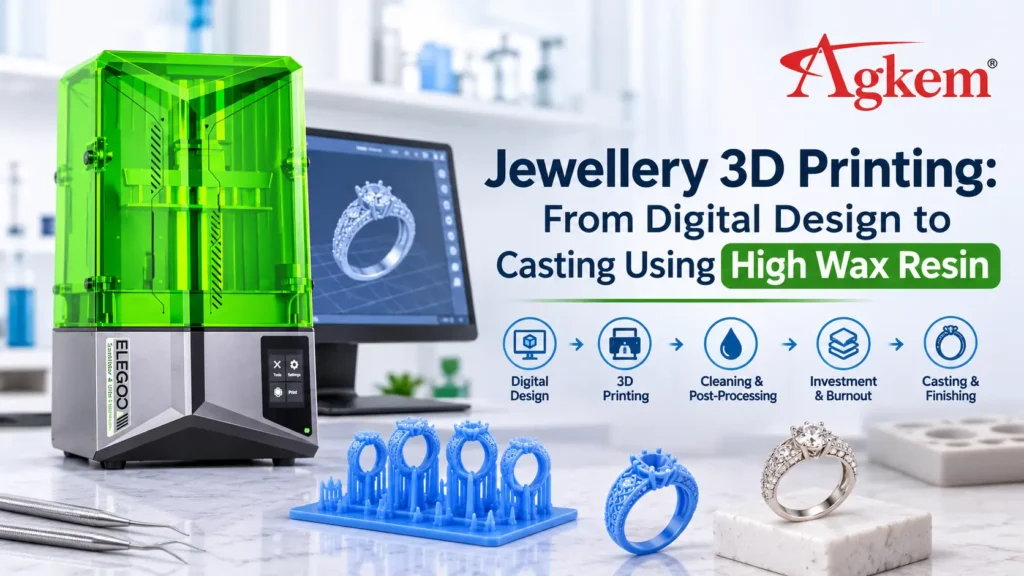
Jewellery manufacturing has changed significantly with the use of digital design and 3D printing. Designs that once required extensive manual model-making can now be created in CAD software, adjusted digitally and printed as physical patterns ready for casting.
Resin 3D printing is particularly useful for jewellery production because it can reproduce intricate details, fine shapes and complex designs.
With high wax resin, printed models can be used in investment casting workflows, helping jewellery manufacturers move from a digital design to a finished metal piece.
The process involves more than printing a model. Design preparation, resin selection, printer settings, post-processing, investment, burnout and casting all affect the final result.
What Is Jewellery 3D Printing?
Jewellery 3D printing is the process of producing jewellery models or patterns from digital designs using additive manufacturing technology. Instead of carving or manually shaping a model, the printer builds the object layer by layer from a digital file.
Resin-based 3D printers are commonly used to create detailed jewellery patterns. The printer uses light to cure liquid photopolymer resin, forming a solid object according to the design file.
These printed patterns can be used for visualisation, design verification, prototyping or casting, depending on the material used.
For jewellery casting, specialised resins such as high wax resin are designed for use in investment casting workflows. The resin pattern is incorporated into the investment process and removed during burnout, leaving a cavity for molten metal.
How Jewellery 3D Printing Works
The jewellery 3D printing process begins with a digital design and ends with a physical pattern that can be used in manufacturing.
1. Creating the Jewellery Design
The jewellery piece is designed using CAD software. The designer creates the shape, dimensions, stone settings, decorative features and other details digitally.
The design can be modified before printing. This makes it easier to adjust dimensions, explore different variations and review the model before committing to physical production.
2. Preparing the Model for Printing
The digital model is exported into a compatible file format, commonly STL or another supported format. The file is then imported into slicing software.
The model is positioned on the build platform, and supports may be added depending on its geometry. The slicing software converts the design into individual layers and prepares the instructions required by the printer.
Print orientation is important. It can affect surface quality, support placement, printing stability and the amount of post-processing required.
3. Printing With Resin
The printer builds the jewellery pattern layer by layer using liquid resin and a light source. Depending on the printer technology, the resin is cured through an LCD screen, projector or another light-based system.
Jewellery designs often contain small details, thin sections and complex shapes. Printer resolution, layer thickness, resin properties and the prepared model all influence the final print.
4. Removing the Printed Model
Once printing is complete, the printed patterns are removed from the build platform. Supports are carefully detached, and the model is cleaned to remove excess resin.
The cleaning and handling process should be appropriate for the resin being used. Incorrect handling can affect delicate printed features.
5. Post-Processing
Printed resin patterns may require additional post-processing, depending on the material and manufacturer’s instructions.
This may include cleaning, drying, support removal and other preparation steps before the pattern is used in the casting workflow.
For casting resins, the manufacturer’s recommended processing procedure should be followed to ensure the pattern is prepared correctly.
What Is High Wax Resin?
High wax resin is a specialised resin used to create patterns for jewellery casting. Unlike standard resins intended for general-purpose 3D printing, casting resins are designed for workflows in which the printed pattern is incorporated into an investment mould and removed during burnout.
The printed pattern represents the jewellery design. After investment and burnout, the pattern is removed from the mould, leaving a cavity that can be filled with molten metal.
High wax resin is used in jewellery manufacturing because it supports digital pattern production and can be incorporated into investment casting processes.
The choice of resin matters. Standard 3D printing resin and casting resin are not interchangeable in every casting workflow. A material must be suitable for the intended burnout and casting process.
High Wax Resin vs Standard 3D Printing Resin
Standard resin and high wax resin may both be used in resin 3D printers, but their intended applications differ.
| Feature | Standard Resin | High Wax Resin |
| Main application | General 3D printing and prototypes | Jewellery casting patterns |
| Intended workflow | Printed object used as a finished or prototype part | Printed pattern incorporated into casting |
| Casting suitability | Depends on resin formulation | Designed for casting workflows |
| Burnout process | Not necessarily suitable for investment casting | Used with a compatible investment and burnout process |
| Material selection | Based on appearance and mechanical properties | Based on casting requirements |
A resin should always be selected according to the intended application and the manufacturer’s processing instructions.
Jewellery Designs That Can Be 3D Printed
Jewellery 3D printing can be used for a wide range of designs.
1. Rings
Rings can include detailed patterns, textured surfaces, stone settings and complex geometries. Digital modelling allows designers to adjust the ring size, profile and decorative elements before printing.
2. Pendants
Pendants often feature intricate shapes, lettering, symbols and decorative details. Resin printing can reproduce these designs as physical patterns for casting.
3. Earrings
Earrings can be designed as matching pairs or as individual pieces. Digital design makes it easier to maintain consistency between components.
4. Bracelets
Selected bracelet designs and components can be created digitally and printed as patterns, depending on the design geometry and casting requirements.
5. Custom Jewellery
Digital jewellery manufacturing is useful for customised pieces. Designs can be modified according to customer preferences, dimensions or specific decorative requirements without rebuilding the entire model manually.
Benefits of 3D Printing for Jewellery Manufacturing
1. Design Flexibility
CAD software allows designers to create and modify jewellery designs before production. Complex shapes, decorative details and variations can be developed digitally.
2. Detailed Pattern Production
Resin 3D printing can reproduce fine features that may be difficult to create through manual pattern-making methods. The final detail depends on the printer, resin, model preparation and printing settings.
3. Easier Design Changes
Digital designs can be edited and reprinted when changes are required. This is useful for customised jewellery and product development.
4. Repeatability
Once a design and print workflow have been established, the same digital model can be used to produce additional patterns. This can help maintain consistency between production batches.
5. Integration With Digital Manufacturing
3D printing can be incorporated into a jewellery production workflow that includes CAD design, casting, finishing, polishing and stone setting.
High Wax Resin Printing Workflow for Jewellery Casting
The workflow from digital design to casting generally follows these stages:
Digital CAD design → File preparation → Resin 3D printing → Cleaning and post-processing → Pattern assembly → Investment → Burnout → Metal casting → Finishing
Each stage affects the quality of the final jewellery piece. The accuracy of the digital model, print orientation, support placement, resin handling, investment preparation and casting conditions all need to be considered.
A printed pattern is only one part of the casting process. Proper preparation and handling throughout the workflow are equally important.
Factors to Consider When Choosing a Jewellery 3D Printer
1. Printer Resolution
Jewellery designs may contain fine details, small text and intricate decorative features. Resolution and print quality should be considered when selecting a printer.
2. Build Volume
The build volume determines the size and number of patterns that can be printed in one batch. A larger build area may be useful for manufacturers printing multiple jewellery patterns together.
3. Resin Compatibility
Check whether the printer is compatible with the casting resin you intend to use. Compatibility includes the printer’s light source, resin curing characteristics and supported material settings.
4. Printing Speed
Printing speed affects production time, but it should be evaluated alongside print quality and reliability. Faster printing is useful only when the workflow produces acceptable patterns consistently.
5. Software and Workflow
The printer’s software, file compatibility, slicing tools and ease of operation are important for everyday production.
6. Maintenance and Support
Consider maintenance requirements, replacement parts, training and technical support before selecting equipment.
Buy Jewellery 3D Printers Online at AGKEM
AGKEM offers resin-based 3D printers from the Elegoo Saturn series for digital manufacturing workflows. These printers use LCD-based resin printing technology to produce detailed models from digital designs.
Elegoo Saturn 4 12K 3D Printer
The Elegoo Saturn 4 12K features a 10-inch monochrome LCD with a resolution of 11,520 × 5,120 pixels and an XY resolution of 19 × 24 μm. It is designed to reproduce fine details in resin prints.
Key features include automatic levelling, a COB light source with a Fresnel collimating lens, a flip-up cover and a self-check function. These features make it an option for jewellery workshops looking to incorporate resin 3D printing into their digital design and pattern-making workflow.
Elegoo Saturn 4 Ultra 16K 3D Printer
The Elegoo Saturn 4 Ultra 16K features a 10-inch 16K monochrome LCD and is designed for high-resolution resin printing. It offers a 14 × 19 μm XY resolution and a build volume of 211.68 × 118.37 × 220 mm.
Its features include automatic levelling, a COB light source with a Fresnel collimating lens, built-in Wi-Fi and USB connectivity. The printer can be considered for workflows requiring detailed resin patterns, subject to compatibility with the resin and intended application.
When selecting a printer for jewellery production, check the printer’s compatibility with casting resin, the recommended exposure settings and the resin manufacturer’s processing instructions.
Buy High Wax Resin for Jewellery Casting at Agkem
AGKEM also offers high wax resin for jewellery printing and casting workflows:
High wax resin is intended for producing patterns that can be incorporated into investment casting workflows. The resin, printer settings, investment material and burnout process should be compatible with one another to achieve the intended casting results.
Jewellery 3D Printing Machine Price in India
The price of a jewellery 3D printer in India depends on its technology, resolution, build volume, speed, software, supported materials and overall configuration.
Entry-level resin printers may be suitable for smaller workshops or businesses beginning with digital pattern production.
Professional printers designed for jewellery manufacturing may offer higher resolution, larger build volumes, workflow features and more consistent production capabilities.
When comparing prices, consider the complete workflow rather than the printer alone. Resin, cleaning equipment, post-processing tools, software, maintenance and training can also contribute to the overall investment.
The best printer is one that matches the size and complexity of your designs, production volume and resin requirements.
Frequently Asked Questions
1. What is jewellery 3D printing?
Jewellery 3D printing is the process of creating jewellery models or casting patterns from digital designs using additive manufacturing technology.
2. Which resin is used for jewellery casting?
High wax resin and other specialised casting resins are used to produce printed patterns for investment casting. The resin must be suitable for the intended casting workflow.
3. Can 3D printed resin jewellery be cast in gold?
Resin patterns can be used in investment casting workflows for producing gold jewellery when the resin, investment material and burnout process are compatible with the casting requirements.
4. What is the difference between high wax resin and normal resin?
High wax resin is intended for casting pattern workflows, while standard resin is generally used for prototypes or printed objects. Their formulations and processing requirements can differ.
5. Is jewellery 3D printing suitable for custom designs?
Yes. Digital design and 3D printing are useful for customised jewellery because dimensions, patterns and decorative details can be modified digitally before printing.
6. What software is used for jewellery 3D printing?
Jewellery designs are commonly created using CAD software. The design file is then prepared using slicing software compatible with the selected 3D printer.
7. How much does a jewellery 3D printer cost in India?
The price depends on the printer’s resolution, build volume, technology, software, supported resin and overall configuration.
From Digital Design to Finished Jewellery
Jewellery 3D printing connects digital design with traditional casting and finishing processes. Designers can develop detailed models digitally, print physical patterns and use those patterns in investment casting workflows.
High wax resin plays an important role in this process by providing a material intended for casting patterns.
Choosing compatible equipment, resin and processing methods helps jewellery manufacturers establish a workflow suited to their designs and production needs.
Explore AGKEM’s jewellery equipment and consumables to find solutions for digital jewellery manufacturing and casting workflows.