
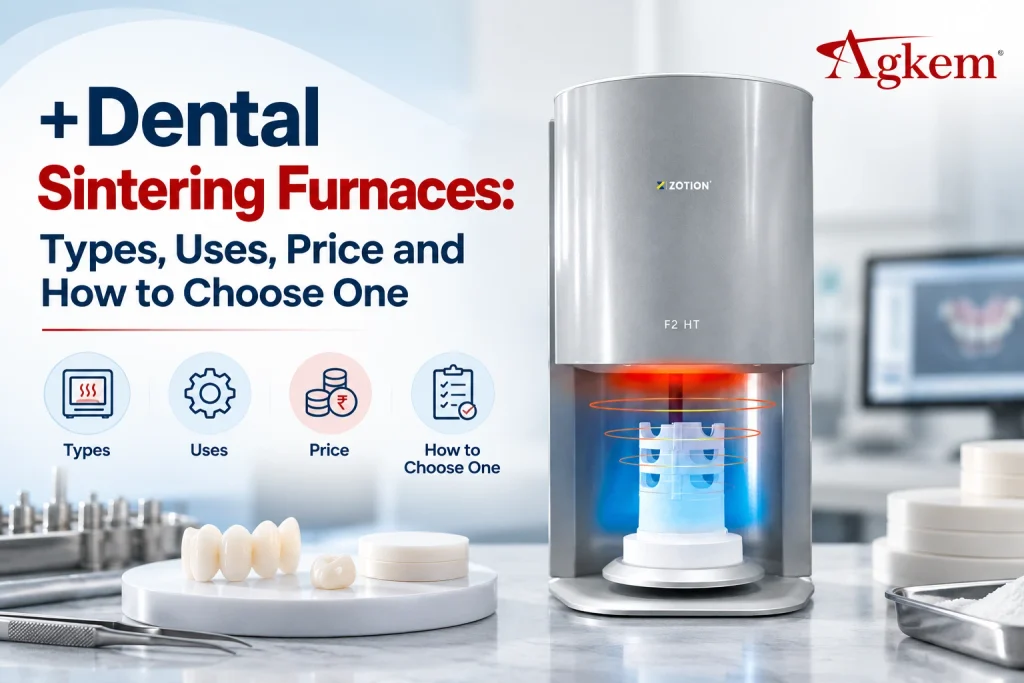
A dental sintering furnace is an important part of a digital dental laboratory that produces zirconia restorations.
After a restoration is milled from a pre-sintered zirconia blank, it must undergo a controlled heating cycle to achieve its intended final properties. The furnace, programme and zirconia material all influence the production workflow.
For dental laboratories investing in CAD/CAM technology, choosing the right furnace involves more than comparing maximum temperature or purchase price.
Cycle time, chamber capacity, programme flexibility, temperature control, material compatibility and daily production requirements also matter.
This guide explains the main types of dental sintering furnaces, their applications, the features to compare and the factors that influence dental sintering furnace prices in India.
What Is a Dental Sintering Furnace?
A dental sintering furnace is a specialised heating unit used to process dental materials such as zirconia according to prescribed temperature cycles.
In a typical zirconia workflow, the restoration is designed using CAD software, milled from a pre-sintered blank and then sintered before finishing and quality checks.
During sintering, the zirconia undergoes controlled densification and shrinkage. The correct programme is essential because the material and restoration must be processed according to the manufacturer’s instructions.
Dental sintering furnaces are used by dental laboratories, milling centres and clinics that manufacture compatible restorations in-house.
The required furnace depends on the zirconia materials being used, the types of restorations produced and the number of cases processed each day.
Types of Dental Sintering Furnaces
1. Standard Zirconia Sintering Furnaces
Standard sintering furnaces are designed for conventional zirconia processing cycles. They are worth considering for laboratories that prioritise routine production and can plan their work around longer sintering cycles.
When comparing standard furnaces, check the chamber dimensions, usable tray capacity, maximum temperature, programme settings and compatibility with the zirconia materials used by your laboratory.
2. Fast Sintering Furnaces
Fast sintering furnaces offer dedicated programmes intended to reduce processing time for compatible zirconia materials.
They can be useful for laboratories managing urgent cases, shorter turnaround targets or higher daily workloads.
However, a fast programme is not automatically suitable for every zirconia blank or restoration.
Confirm the manufacturer’s recommended cycle and whether the material supports the proposed heating and cooling schedule before using a rapid programme.
AGKEM has the F2 Fast Sintering Furnace and the Champion ZTCF-30B in its dental sintering furnace category.
3. Furnaces With Multiple Sintering Programmes
Some furnaces provide both standard and fast cycles, alongside programmable settings for different workflows.
This flexibility can help laboratories handle varied cases without relying on a single processing schedule.
Before buying, check how many programmes can be stored, whether parameters can be edited, how easily programmes can be selected and whether the interface supports your team’s daily workflow.
What Is a Dental Sintering Furnace Used For?
The primary application is processing zirconia restorations after milling from pre-sintered blanks. Depending on the material and laboratory workflow, these restorations may include:
- Dental crowns
- Multi-unit bridges
- Other zirconia restorations supported by the material and equipment specifications
The furnace is one stage in the complete production process. Scanning, digital design, milling, sintering, finishing and quality control must work together to achieve a suitable result.
A furnace should therefore be selected according to the restorations your laboratory produces, the zirconia brands and formulations you use, and the output you need to maintain.
Important Features to Compare Before Buying
1. Maximum Temperature and Temperature Control
Check the maximum operating temperature and the manufacturer’s stated temperature-control specifications.
These details help determine whether the furnace is appropriate for your intended materials and programmes.
Maximum temperature alone should not determine the purchase. Temperature consistency, programme control and compatibility with the material’s sintering instructions are also important.
2. Standard and Fast Sintering Cycles
If turnaround time is a priority, compare the complete cycle duration rather than only the heating time. Include heating, holding and cooling when evaluating how quickly a restoration can be ready for the next stage.
Also confirm which zirconia materials are approved for the fast cycle and whether the programme meets their processing requirements.
3. Chamber Size and Batch Capacity
The chamber determines the space available for trays and restorations. A compact chamber may suit a laboratory with lower production volume, while a larger or multi-layer configuration may be useful for laboratories processing multiple cases together.
Compare usable chamber dimensions, tray configuration and the manufacturer’s stated capacity.
The number of restorations that can be processed in one cycle will depend on their size, arrangement and the prescribed programme.
4. Programmable Settings
Multiple programmes can be useful when a laboratory works with different materials or processing schedules.
Check whether the furnace allows programme storage, parameter adjustment and easy selection of saved cycles.
Power-failure memory or recovery features may also be worth evaluating where uninterrupted production is important.
5. Heating Elements and Insulation
Heating components and chamber insulation affect the furnace’s operating design and maintenance requirements.
Review the manufacturer’s specifications and ask about expected maintenance, replacement components and service availability.
Do not compare machines on heating-element material alone. Consider the complete equipment specification and the support available after purchase.
6. Installation and Electrical Requirements
Check the furnace’s voltage, power rating, dimensions, weight and installation requirements before ordering.
Make sure the laboratory has suitable space, electrical supply and operating conditions.
Also ask about installation support, staff training, warranty coverage and the availability of technical assistance.
Dental Sintering Furnace Price in India
The price of a dental sintering furnace in India depends on the model, chamber capacity, heating system, temperature-control specifications, programmable functions and availability of fast-sintering cycles.
A basic furnace for routine production may have different requirements from a system designed for higher throughput or multiple processing programmes.
Accessories, installation, warranty and after-sales support can also affect the overall investment.
When comparing quotations, evaluate:
- Purchase price and included accessories
- Standard and fast-cycle capabilities
- Chamber capacity and batch requirements
- Supported zirconia materials and programmes
- Power consumption and installation needs
- Maintenance, warranty and technical support
There is no single price that applies to every dental sintering furnace. Contact the supplier for a current quotation based on your required configuration and intended applications.
Buy Dental Sintering Furnaces Online at AGKEM
AGKEM offers dental laboratory equipment for different stages of digital dentistry, including sintering furnaces used in zirconia workflows.
Champion Sintering Furnace ZTCF-30B
The Champion ZTCF-30B is listed as a fast zirconia sintering furnace with both fast and standard programmes. AGKEM’s product information specifies a fast cycle of approximately 65 minutes, including heating, holding and cooling, along with a maximum temperature of 1730°C and a 7-inch TFT colour touchscreen.
It comes with a temperature-control accuracy of ±1°C, 40 programmes and a chamber size of approximately 110 × 120 mm.
F2 Fast Sintering Furnace
The F2 Fast Sintering Furnace is another option in AGKEM’s dental sintering furnace category. It is intended for laboratories evaluating faster zirconia processing cycles.
Before selecting the F2, confirm the current specifications, supported zirconia materials, recommended programmes and actual end-to-end cycle duration for your intended applications.
How to Choose the Right Dental Sintering Furnace for Your Laboratory
Start by reviewing your current and expected production requirements.
A laboratory processing a small number of routine zirconia restorations may prioritise reliability, straightforward operation and suitable chamber capacity.
A laboratory handling urgent cases or larger workloads may place greater value on compatible fast-sintering programmes and batch throughput.
Use this checklist before making a decision:
- Identify your materials: Confirm the zirconia brands and material types you use.
- Estimate daily output: Calculate the number and types of restorations processed per shift.
- Compare cycle times: Consider the full heating, holding and cooling process.
- Check chamber capacity: Match the chamber and tray configuration to your workload.
- Review programme flexibility: Check standard cycles, fast cycles and saved settings.
- Calculate the total investment: Include installation, accessories, maintenance and support.
- Confirm service availability: Ask about warranty terms, training and technical assistance.
If you are also investing in a milling machine, consider the furnace as part of the complete CAD/CAM workflow.
The aim is to maintain a practical balance between milling output, furnace capacity and finishing time.
Frequently Asked Questions
1. What is a dental sintering furnace used for?
A dental sintering furnace is commonly used to process zirconia restorations after milling from pre-sintered zirconia blanks. The restoration must follow the appropriate material-specific sintering cycle.
2. What is the difference between a standard and fast sintering furnace?
A standard furnace uses conventional processing cycles, while a fast sintering furnace offers programmes designed to reduce cycle time for compatible materials. Suitability depends on the zirconia manufacturer’s instructions and the furnace’s specifications.
3. How much does a dental sintering furnace cost in India?
The price depends on the model, chamber capacity, temperature control, programme options and other specifications. Request a current quotation for the configuration that meets your laboratory’s requirements.
4. Can every zirconia restoration be fast-sintered?
No. Fast sintering should only be used when the zirconia material and restoration are compatible with the recommended programme. Always follow the material manufacturer’s instructions.
5. What temperature should a dental zirconia furnace reach?
The required temperature depends on the zirconia material and its prescribed sintering cycle. Choose a furnace that supports the temperature and programme requirements specified by the material manufacturer.
6. How do I choose the right furnace capacity?
Consider your daily production volume, restoration sizes, tray arrangement and the number of cases you want to process per cycle. Confirm the usable chamber dimensions and stated capacity before purchase.
7. Is a fast sintering furnace suitable for every dental laboratory?
Not necessarily. It can benefit dental laboratories that need shorter turnaround times, but the value depends on production volume, compatible materials, programme requirements and budget.
8. Where can I buy a dental sintering furnace in India?
AGKEM currently has dental sintering furnaces, including the Champion ZTCF-30B Plus and F2 Fast Sintering Furnace.
You can review the available models here and contact the team for current pricing and product details.
Choose a Dental Sintering Furnace That Fits Your Workflow
The right dental sintering furnace should match your zirconia materials, restoration types, production volume and turnaround requirements.
Comparing the complete processing cycle, chamber capacity, programme options, installation requirements and after-sales support will help you make a more informed equipment decision.
Explore AGKEM’s dental sintering furnace range to compare available models and identify a system that fits your dental laboratory’s digital production workflow.